
A research project exploring the impacts of mountaineering activities on the Seven Summits has reached a new peak, with three climbs thus far undertaken.
The project, led by Charles Darwin University (CDU) in collaboration with global mountaineering guide service Climbing the Seven Summits (CTSS), is investigating the regional economic, environmental and social ecosystem impacts of traversing the highest peaks on each of the seven continents.
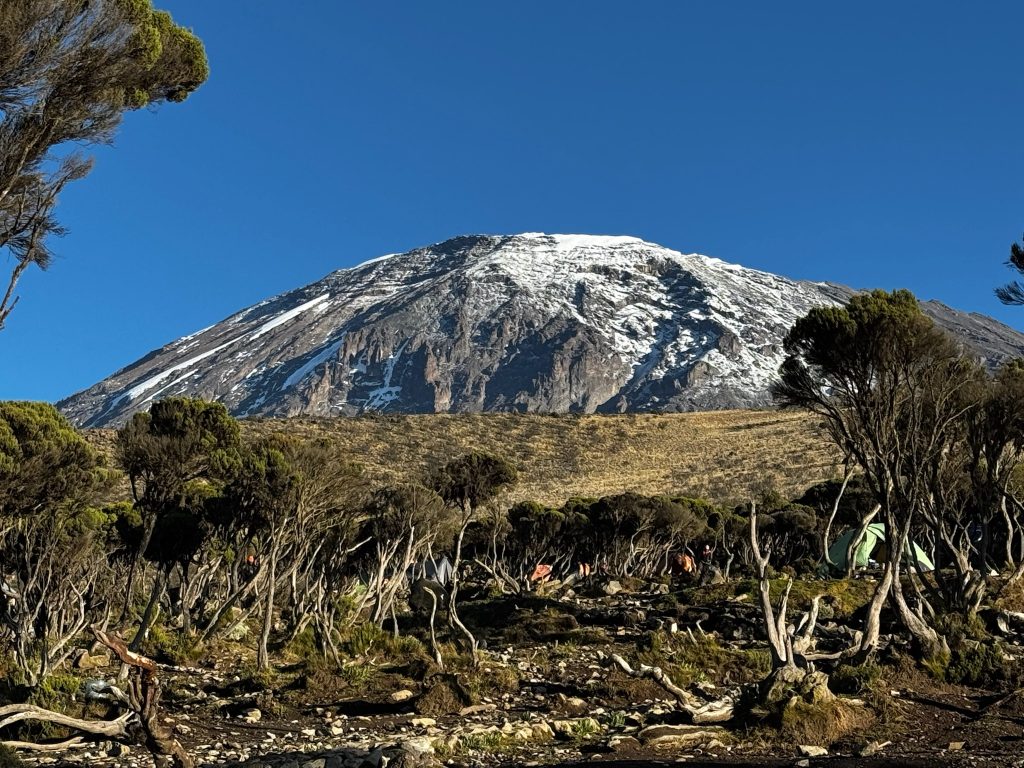
Principal researcher, CDU Lecturer in Sustainability Leadership and Management and adventurer, Dr Chrystie Watson, said her most recent climb on Tanzania’s Mount Kilimanjaro, which has a peak of 5895 meters, underscored the socio-economic importance of these destinations.
“Local communities rely on the economic and social benefits realized through the global appeal of the mountain, drawing visitors from around the world,” Dr Watson said.
“Tens of thousands of local jobs are associated with visitors to the Kilimanjaro region, including guide and porter services as well as park management and local businesses.
“Those who come to Tanzania to climb Mount Kilimanjaro often spend additional time exploring Tanzania and surrounding regions, participating in safaris and other tours offered by local guide companies.
“Tanzania has a deep history of Chagga and Maasai people who openly share their history through tours of ancient Chagga caves and tunnels, Chagga and Maasai agricultural practices and language.”
This climb is part of a multidisciplinary CDU project assessing the effectiveness of mountaineering management strategies, exploring the environmental psychology of mountaineers, and reviewing industry practices.
The highest peaks on each of the seven continents are Mount Kosciuszko in Australia, Mount Everest in Asia, Mount Kilimanjaro in Africa, Denali in North America, Aconcagua in South America, Vinson Massif in Antarctica, and Mount Elbrus in Europe – with Mont Blanc, on the border of France and Italy, currently serving as a proxy for Mount Elbrus in Russia.
Thus far, Dr Watson has traversed Mount Kosciuszko in 2024, Mont Blanc in 2025, and Mount Kilimanjaro in January 2026.
A second climb of Mont Blanc is scheduled in June this year for further exploration as part of an expansion of the project in partnership with local Chamonix based guide company, Adventure Base.
Dr Watson is planning to climb Aconcagua in Argentina with CTSS in early 2027.
The importance of mountain environments as essential to global ecosystems and local regions is central to this work as these continue to experience serious and increasing environmental degradation.
Mount Everest is one of the most prominent examples, with the region receiving up to 100,000 visitors each year, resulting in erosion and significant amounts of waste left behind.
“Glacial melt and run-off from the mountains feeds river systems which serve as vital water sources and support local agriculture and livelihoods," Dr Watson said.
“Mountaineers and mountain workers play a key role in managing the impacts of their activities on the mountain.
“On Kilimanjaro, our Tanzanian guides collected rubbish along the trail left by other climbers which was later transported down the mountain by porters, however,” as Dr Watson explains, “preventative solutions are necessary and the responsibility of every climber.”
Dr Watson and Dr Michael Erdiaw-Kwasie from CDU's Faculty of Arts and Society are leading business sustainability research and Professor Kim Caudwell and Dr Matthew Abunyewah from the Faculty of Health will explore the environmental psychology aspect.
Visit Support CDU’s Seven Summits Sustainability Project for more information.
Contact details:
Raphaella Saroukos she/her
Research Communications Officer
Marketing, Media & Communications
Larrakia Country
T: +61 8 8946 6721
E: [email protected]
W: cdu.edu.au
Charles Darwin University acknowledges all First Nations people across the lands on which we live and work, and we pay our respects to Elders both past and present.
CRICOS Provider No. 00300K (NT/VIC) I 03286A (NSW) | RTO Provider No. 0373 | TEQSA Provider ID PRV12069