
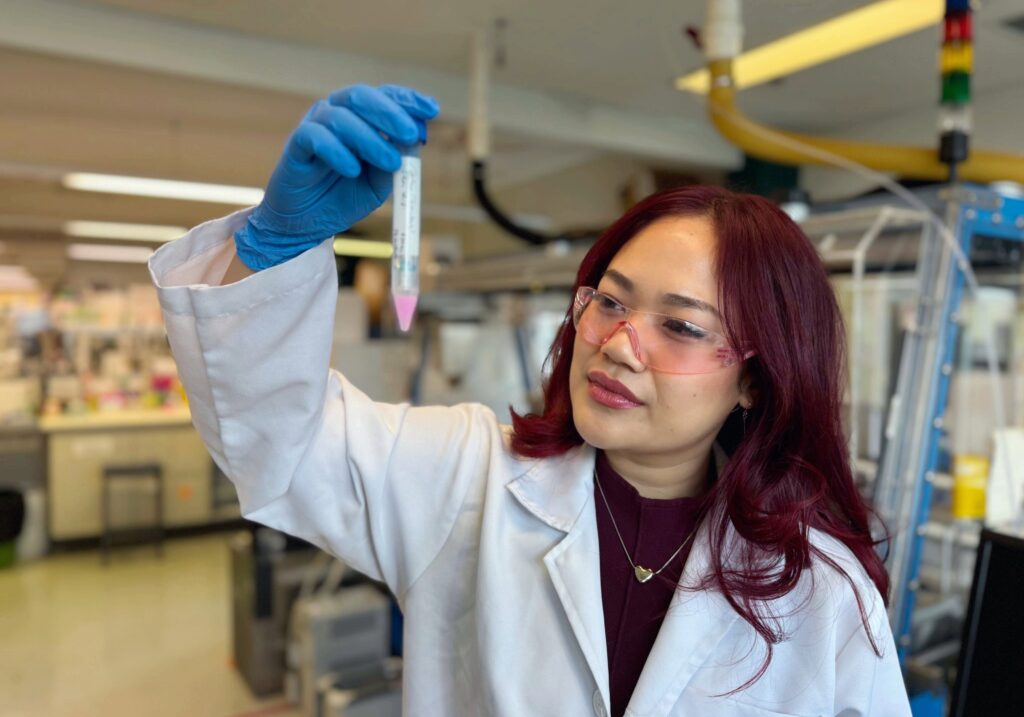

Scientists have discovered that the internal shape of tiny drug-delivery particles – called lipid nanoparticles – has a big impact on how well our cells absorb them, paving the way to more efficient vaccine and drug delivery.
The RMIT University and Osaka University study published in top journal Small is the first to reveal that certain lipid nanoparticle shapes are absorbed by cells up to eight times better than others, with significant implications for mRNA gene therapy design.
Lipid nanoparticles have emerged as critical platforms for drug and gene delivery, with the success of mRNA COVID-19 vaccines highlighting their potential.
Yet our understanding of how to deliver these mRNA gene therapies to target cells more efficiently remains limited, explained study first author Sue Lyn Yap.
“One of the major challenges in nanomedicine is that most nanoparticles are taken up by cells through pathways that trap and degrade them, with studies showing less than 2% of gene therapies successfully reach their target inside the cell,” said Yap, who is in the final stages of her PhD at RMIT University in Australia.
These nanoparticles have different internal structures such as layers (liposomes) or more complex 3D cubic shapes (cubosomes), with researchers discovering that these shapes have a big impact on what pathways they take to enter cells.
Cubosomes are tiny nanoscale particles formulated from the self-assembly of lipids in water. The lipids self-assemble into an intricate and complex 3D cubic structure, with water channels and lipid bridges running throughout the entire particle that can be used to package small molecule drugs.
In vitro tests using an epithelial cell line found cubosomes were the most efficient at entering cells.
The study revealed cubosomes were eight times more likely to enter the cells than liposomes, which are what most lipid-based nanomedicines and commercial products use today.
This finding opens a new frontier in designing lipid nanoparticles to deliver drugs more efficiently.
“What we found really interesting was that these particles don’t rely just on the usual active processes to enter cells, like endocytosis, where the cell swallows them,” Yap said.
“We discovered that cubosomes can also enter cells through other more passive routes, such as fusing with the cell membrane directly, essentially sneaking past the cellular barriers that usually destroy them.
“Next, we aim to explore how these structured nanoparticles behave in the body and whether they can be tailored to target specific tissues or diseases more precisely,” she said.
The groundbreaking collaboration was supervised by corresponding authors RMITs Distinguished Professor Calum Drummond AO, Professor Charlotte Conn and Dr Nhiem Tran in collaboration with researchers at Osaka University, Japan.
The research spread across multiple facilities including the Australian Synchrotron (ANSTO), the RMIT Micro Nano Research Facility (MNRF), the Molecular Assembly Lab at RMIT, the Ian Holmes Imaging Centre (Bio 21 Institute), and the Biophotonics Laboratory (Immunology Frontier Research Center) at Osaka University.
‘The Internal Nanostructure of Lipid Nanoparticles Influences Their Diverse Cellular Uptake Pathways’ is published in Small (DOI:10.1002/smll.202500903).
Contact details:
Michael Quin
0499 515 417