Company reveals world’s first 100% electrochemical pathway for producing e-kerosene directly from atmospheric CO2 and renewable electricity without hydrogen, making Fischer-Tropsch obsolete.
SANTA CRUZ, Calif.--BUSINESS WIRE--
Prometheus Fuels today announced its revolutionary new pathway for producing synthetic paraffinic kerosene (the basis for SAF jet fuel and e-diesel) from direct air capture of CO2 and off-grid renewable electricity. The new Prometheus e-kerosene pathway makes Fischer-Tropsch synthesis obsolete, reducing the cost to make e-fuels by more than 80 percent compared to the century-old technology. It is also the first process in history to make kerosene from electricity and atmospheric CO2 without using hydrogen. The kerosene produced is 100 percent carbon neutral. Two independent engineering reviews confirmed demonstration of the new pathway using commercial-scale cells.
This press release features multimedia. View the full release here: https://www.businesswire.com/news/home/20260114310118/en/
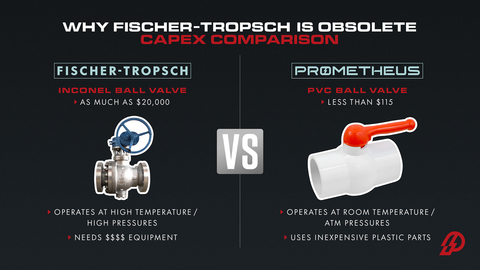
Because the Prometheus e-kerosene pathway operates at ambient temperatures and pressures, it uses much less expensive equipment than the high-temperature, high-pressure Fischer-Tropsch process. This is just one example of several major cost drivers of conventional e-fuel production Prometheus has eliminated with its breakthrough e-kerosene pathway. ©Prometheus Fuels
The announcement follows the company’s recent milestone achievement of completing a one-year pilot-scale demonstration of its DAC-to-fuels technology platform, producing e-methanol at its Titan Forge Alpha pilot facility. The pilot and its operating data were validated by two independent engineering reviews, in November and December of 2025.
For the first time, Prometheus is releasing details of its new 100 percent electrochemical synthetic paraffinic kerosene pathway, which uses CO2 captured from the air using the company’s proprietary “No-Desorb DAC” process. A key breakthrough that made the new kerosene pathway possible is a process the company calls “electrochemical oligomerization.” Oligomerization is the combining of smaller monomers into larger molecules, like hydrocarbons. One example of this is carbon-carbon chain lengthening. In the Fischer-Tropsch process, this chain lengthening occurs due to the high pressures and temperatures that process requires. It is these extreme operating conditions, which require expensive equipment and 24-7, grid-connected power, that keep the cost of Fischer-Tropsch e-fuels permanently high. In contrast, Prometheus has developed the ability to achieve its carbon-carbon chain lengthening using electromagnetic fields and electric currents in water at room temperature and atmospheric pressure. With these ambient operating conditions, the Prometheus process uses equipment that is much less expensive and can be powered by intermittent, off-grid solar, allowing access to the lowest energy input costs.
The new pathway eliminates the major cost drivers of conventional e-fuels systems. It does not desorb CO2 into a pure gas stream; does not use hydrogen; does not rely on high-temperature or high-pressure reactors; and was purpose-built to operate on intermittent off-grid renewable electricity – the cheapest electrons in the world – avoiding the high cost and geographic constraints of being connected to a grid. There is also no need for distillation. Kerosene forms directly in Prometheus’ Faraday Reactor hydrocarbon electrolyzer and self-separates from water, at room temperature and atmospheric pressure, producing finished kerosene fuel. Notably, the Prometheus e-kerosene pathway has linear cost scaling, allowing it to achieve its low costs across a wide range of production scales, from pilot systems to commercial plants.
“Our new kerosene pathway takes e-fuels beyond decarbonization to direct economic competition with oil-based fuels,” said Rob McGinnis, founder and CEO of Prometheus. “Our pathway puts three holy grails of energy within reach: a new source of energy for data centers, limitless low-cost SAF, and unblockadeable fuel logistics for defense. The implications of this new technology – the advantages it creates for energy independence and national security – are profound.”
Until now, Prometheus had shared only high-level descriptions of its technology while it focused on building and securing its patent and trade secret portfolio. With its IP portfolio secure, Prometheus is able to release more details about its technology and competitive advantages in global commodity energy markets.
About Prometheus Fuels
Prometheus is the global leader in fuels made from air and electricity to power AI data centers, factories, ships, vehicles, and aircraft. The company’s patented technology produces carbon neutral fuels that are cost-competitive with commodity fossil fuel prices without subsidies. Designed to run off-grid, Prometheus offers an infinitely scalable source of new energy, transforming intermittent renewable electricity into firm dispatchable 24/7 power, anywhere it is needed. Backed by top-tier investors including Maersk, BMW, and Y Combinator, Prometheus is redefining the future of energy. Learn more at prometheusfuels.com and prometheusfuels.AI.
View source version on businesswire.com: https://www.businesswire.com/news/home/20260114310118/en/
Contact details:
Media Contact
Amanda Martinez for Prometheus Fuels: [email protected]