
Key points
- Researchers have revealed trillions of microbes live in the bark of every tree
- Tree microbes clean the air by removing greenhouse and toxic gases
- This suggests planting trees offers climate benefits beyond CO2 removal
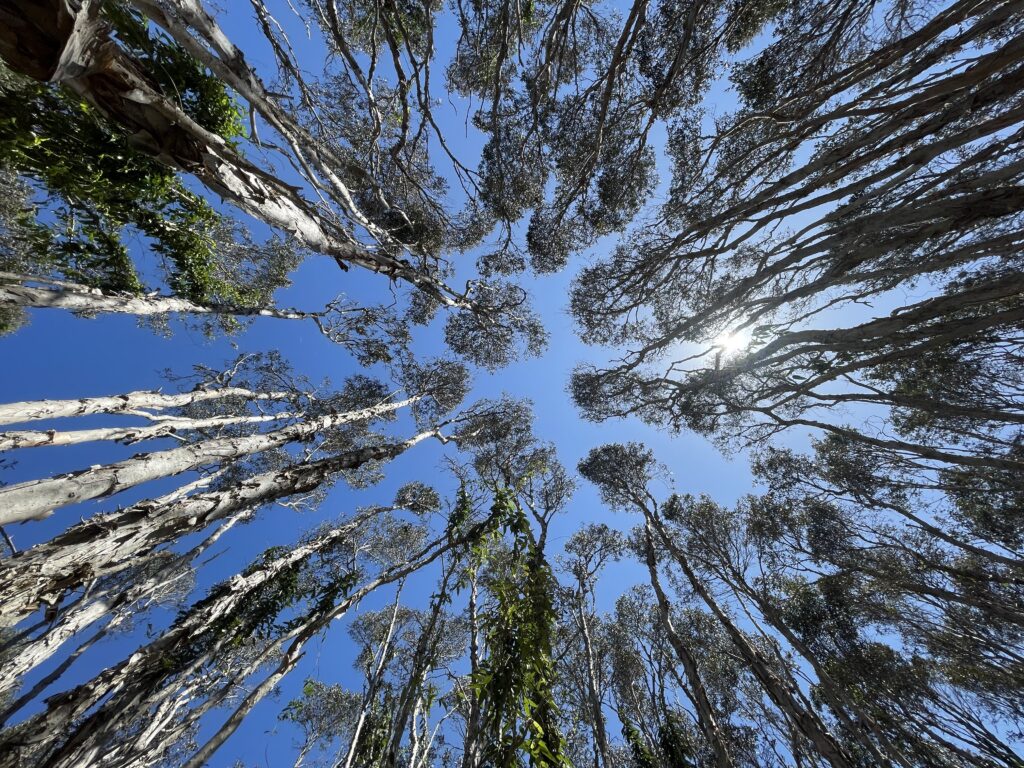
Australian researchers have discovered a hidden climate superpower of trees. Their bark harbours trillions of microbes that help scrub the air of greenhouse and toxic gases.
It’s long been known that trees fight global warming by consuming carbon dioxide (CO2) through photosynthesis. But a new study published in Science shows their microbial partners take up vast amounts of other climate-active gases too.
The study, conducted primarily by Dr Bob Leung at Monash University’s Biomedicine Discovery Institute (BDI), and Dr Luke Jeffrey at Southern Cross University’s Faculty of Science and Engineering, rewrites our understanding of how trees and their resident microbes shape the atmosphere.
“Each tree hosts trillions of microbial cells on its bark,” said Dr Leung, a co-first author. “Yet their existence and roles have been overlooked for many decades until now.”
The researchers spent five years sampling trees across eastern Australia, including wetland, upland, and mangrove forests.
They then used advanced genomic and biogeochemical techniques to determine, for the first time, the identities, capabilities and activities of the microbes living in their bark.
“Remarkably, most of these microbes are tree-adapted specialists that feed on climate-active gases,” Dr Leung said. “They consume methane, hydrogen, carbon monoxide, and even volatile compounds released by the trees themselves.”
Dr Jeffrey, also a co-first author, said the scale of this hidden process was staggering.
“Counting all trees on Earth, the total global surface area of bark covers an area roughly the same as all seven continents combined,” he said. “This microbial activity across this massive ‘bark continent’ is potentially removing millions of tonnes of climate-active gases every year.
“These gases can come from the atmosphere or from within tree stems. By consuming these unwanted gases, microbes in bark are essentially cleansing our air and enhancing the benefits of trees in multiple ways.”
The BDI’s Professor Chris Greening, who co-led the study with Southern Cross University’s Professor Damien Maher, said there was much long-term potential to use these findings for climate action.
“We now know different trees host different microbes,” Professor Greening said. “If we can identify the trees with the most active gas-consuming microbes, they could become priority targets for reforestation and urban greening projects.”
Professor Greening added that the discovery could benefit both climate and human health. “In addition to being a climate-active gas, carbon monoxide is also a toxic air pollutant,” he said. “Tree microbes are helping scrub it from the air and so improve air quality.”
Professor Maher said there were many more discoveries to be made in this research area. “This research is really the tip of the iceberg in terms of expanding our understanding of how trees and microbes interact,” he said.
“The diversity of microbes that we found living in the bark of these trees suggests that we may need to rethink how trees and forests control Earth’s climate now and into the future”.
The tree species included paperbark (Melaleuca quinquenervia), Swamp box (Lophostemon suaveolens) and Swamp oak (Casuarina glauca) from freshwater wetland forest; Banksia (Banksia integrifolia) and Golden wattle (Acacia longifolia) from coastal heath forest; Mangrove (Avicennia marina) from mangrove forest; Grey ironbark (Eucalyptus siderophloia) and Grey Gum (Eucalyptus propinqua) from upland forest.
Read the full paper, published in Science, titled Bark microbiota modulate climate-active gas fluxes in Australian forests, at https://doi.org/10.1126/science.adu2182
Vision and images available here.
MEDIA ENQUIRIES
Toni Brient
Media and Communications Manager
[email protected]
P: +61 423 964 191
For more experts, news, opinion and analysis, visit Monash News.
GENERAL MEDIA ENQUIRIES
Monash Media
E: [email protected]
T: +61 (0) 3 9903 4840
About the Monash Biomedicine Discovery Institute
Committed to making the discoveries that will relieve the future burden of disease, the Monash Biomedicine Discovery Institute (BDI) at Monash University brings together more than 120 internationally-renowned research teams. Spanning seven discovery programs across Cancer, Cardiovascular Disease, Development and Stem Cells, Infection, Immunity, Metabolism, Diabetes and Obesity, and Neuroscience, Monash BDI is one of the largest biomedical research institutes in Australia. Our researchers are supported by world-class technology and infrastructure, and partner with industry, clinicians and researchers internationally to enhance lives through discovery.