
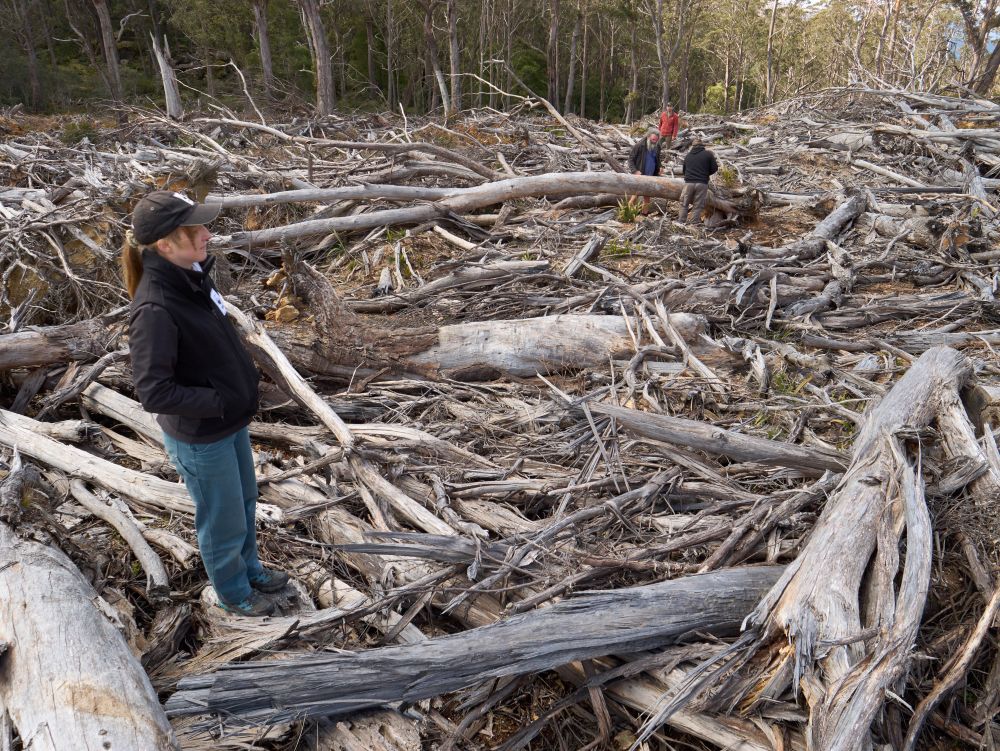

One in 5 failure rate for regeneration devastating for wildlife
Stills and some video here: https://dams.wwf.org.au/resourcespace/?c=6489&k=f88b7721e3
Large areas of native forest in New South Wales are not recovering after logging – a devastating result for threatened species and the environment.
Conservationists say it’s another reason why the NSW government should transition out of native forest logging and into plantations.
The federal government’s state of the forests report says native forests in NSW have an effective regeneration rate of 81% after logging.
But that means nearly 20% of logged areas are not restoring – a one in five failure rate.
To make matters worse, under the official definition of regeneration, forest compartments that are reported as recovering could in reality have just a sparse scattering of seedlings.
One of the ways Forestry Corp NSW can assess regeneration is to survey a logged compartment after two to five years by checking 50 randomly selected, 16 m² plots.
If a plot has just one single tree seedling it qualifies as regeneration. All 50 plots could each have a single seedling and that would equal a regeneration rate of 100%. A regeneration rate above 65% is deemed acceptable.
The World Wide Fund for Nature-Australia, Wilderness Australia, and South East Forest Rescue returned to Tallaganda State Forest two years after logging to assess recovery.
In a logged area, they found a mix of sun-baked ground largely devoid of vegetation and piles of waist-high timber debris. There were virtually no signs of recovery.
Previously, it was a thriving forest with a healthy population of endangered greater gliders and other threatened species.
While on site they demonstrated what so-called successful regeneration can look like under the current definition. They marked out a 16 m² plot with red tape around bare earth with a single seedling – under the assessment rules this represents successful regeneration.
Dr Kita Ashman, a WWF-Australia conservation scientist, said:
No reasonable person would look at a barren patch of ground with a single seedling and think that’s forest regeneration. But that’s what can happen under the rules. Forestry Corp is trashing our native forests and failing on regeneration all while haemorrhaging taxpayers’ money. Our forests are so much more valuable left standing. It’s time for a just transition to timber plantations.
Andrew Wong, Operations Manager, for Wilderness Australia said:
"Native forest logging is an industry based on failed promises. The impression they give is that they will regenerate all the forests they log, protect endangered species, and turn a profit. They don’t do any of these things. It’s a destructive fiction. In reality, they harm native species, seriously degrade forests, and run at a loss funded by taxpayers."
Scott Daines, spokesperson for South East Forest Rescue, said:
There are areas in Glenbog State Forest logged in 2017 that show no signs of regenerating after eight years. When natural recovery fails, Forestry Corp is required to take remedial or rehabilitation action. But nothing has happened. It’s an absolute joke.
Last year the EPA filed 29 charges against Forestry Corp for alleged breaches of forest and biodiversity laws in Tallaganda and that matter is still before the Land and Environment Court.
In December 2025, Forestry Corp’s annual report showed the hardwood division, which logs native forests, lost $32 million in the 2024–25 financial year. This takes the hardwood division’s losses since 2020-21 to a staggering $105 million.
Contact details:
Mark Symons
Senior Media Officer, WWF-Australia
m 0400 985 571