
Peer-reviewed feasibility pilot trial reports reduced eating disorder and depressive symptoms in difficult-to-treat psychiatric condition
SAN MATEO, Calif.--BUSINESS WIRE--
A pilot study published today in Communications Medicine demonstrates the potential of a new approach to treating anorexia nervosa — a disorder for which effective treatments have been significantly limited. The research from UC San Diego School of Medicine reports that a ketogenic nutritional intervention — a high-fat, low-carbohydrate, moderate-protein diet — was feasible and safe for patients with weight-normalized and mildly underweight anorexia nervosa. The ketogenic intervention was well-tolerated by participants, with high adherence rates and no significant weight loss observed throughout the program. Furthermore, significant improvements were observed in eating disorder symptoms, with nearly 3 in 4 of study completers in the recovered range at study end, no longer meeting criteria for an anorexia nervosa diagnosis, and all completers experiencing an improvement in depression scores.
This press release features multimedia. View the full release here: https://www.businesswire.com/news/home/20260603955892/en/
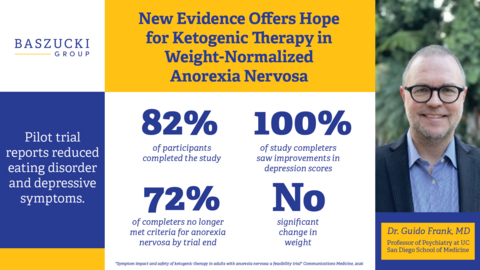
New Evidence Offers Hope for Ketogenic Therapy in Weight-Normalized Anorexia Nervosa
Anorexia nervosa is a devastating psychiatric disorder with among the highest mortality rate of any mental illness; in the United States, a death occurs every 52 minutes as a result of this disorder or its complications. Even after successful weight restoration, patients often struggle with persistent psychological symptoms — including body dissatisfaction, an intense fear of eating, and a preoccupation with shape — that drive an alarmingly high risk of relapse.
Study lead Guido Frank, MD, Professor of Psychiatry at UC San Diego School of Medicine, who has been studying and treating anorexia patients for over 25 years, launched this study to broaden treatment options for this high-risk population. “We urgently need new approaches to anorexia nervosa. Our work with ketogenic therapy looks beyond standard therapies and potentially at the underlying physiology of the disorder," states Dr. Frank. “Growing evidence links anorexia nervosa to neurometabolic dysfunction, and we are hopeful that direct metabolic intervention can regulate neural function and address the psychological symptoms patients experience.”
The outpatient, nationwide, single-arm clinical study delivered a supervised 14-week ketogenic intervention, with 18 of the 22 enrolled participants (82%) completing the study. No significant change in weight was observed throughout the program (as measured by BMI). By the end of the study, 72% of study completers reached the recovered range of eating disorder symptoms as measured by eating disorder scales (Eating Disorder Examination Questionnaire, EDE-Q, and Eating Disorder Inventory-3, EDI-3) and all showed improvements in depression scores (as measured by the Beck Depression Inventory, BDI), with 72% within normal range.
For co-author Barbara Scolnick, MD, an internal medicine physician in Waban, Massachusetts, this study is the culmination of a decade-long personal journey. “The scientific inquiry that led to this research began in search of answers for my niece, Caroline Beckwith,” Dr. Scolnick shared. “Ketogenic therapy, a standard in epilepsy care, was the major catalyst, when combined with other interventions, that allowed Caroline to achieve remission after a 15-year struggle with anorexia nervosa. I am encouraged by these preliminary findings, which indicate that this treatment may provide a path forward for others like Caroline.”
While the authors acknowledge the clinical sensitivities of dietary interventions in this patient population, this study builds on priorpreliminaryevidence to provide proof of concept. The findings indicate that, when delivered with specialized medical supervision and trained support, ketogenic therapy holds potential for those who have failed to respond to traditional treatments.
“This study highlights the promise of dietary interventions that target normalizing underlying neurometabolic function for even the most intractable psychiatric conditions like anorexia nervosa,” said Jan Ellison Baszucki, co-founder and president of Baszucki Group, who funded the study. “We hope this work drives awareness and support for researching and delivering ketogenic therapy for eating disorders, providing new hope for patients and their families.”
A current extension of this study, for patients with both anorexia nervosa and bulimia nervosa diagnoses, is underway and recruiting participants nationally. Those interested in learning more or joining the study can find more information at the study site.
About Baszucki Group
Launched in 2021 by Roblox founder and Chief Executive Officer David Baszucki and best-selling author Jan Ellison Baszucki, Baszucki Group leverages grantmaking, impact investing, advocacy, storytelling, and community building to drive foundational change in science, medicine, farming, food, and environmental ecosystems. A primary focus of Baszucki Group is supporting initiatives at the intersection of metabolism, psychiatry, and neuroscience with the goal of improving mental health outcomes. To learn more about metabolic approaches to mental disorders and brain health, including ketogenic therapy, visit Metabolic Mind, a nonprofit initiative of Baszucki Group.
View source version on businesswire.com: https://www.businesswire.com/news/home/20260603955892/en/
Contact details:
Baszucki Group media contact: [email protected]