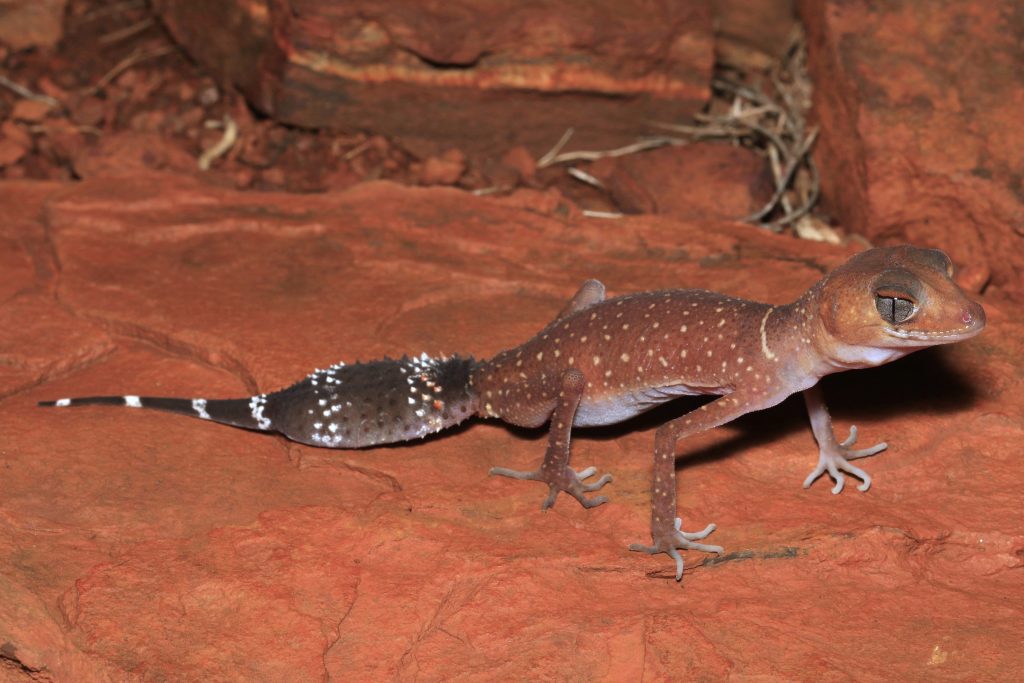

New research from Monash University has provided the first comprehensive assessment of the Pilbara barking gecko (Underwoodisaurus seorsus) and revealed the species is facing a heightened risk of extinction under a rapidly warming climate.
The Pilbara barking gecko is one of Australia's most little-known and poorly understood reptile species, and is endemic to the Hamersley Range in the Pilbara region of Western Australia.
This mysterious species has a distinct, sharp, dog-like bark which it emits when it is startled, threatened, or defending its territory. It also prefers high-elevation and cooler temperatures, unlike most other reptiles that chase the heat. Adding to its mystery, only 55 sightings have been recorded of this gecko prior to this study.
The study, published in Pacific Conservation Biology, integrated five months worth of field surveys, analyses of habitat, life history, and climate modelling to reveal a hidden extinction risk and as a result, inform proactive, evidence-based conservation planning for the Pilbara barking gecko.
Project lead, Robert Audcent, a Bachelor of Science Honors Graduate from Monash University, explains how the gecko’s preference towards mountainous environments, hundreds of metres above the surrounding plains, was a vital clue in understanding its habits.
“The Pilbara region is expected to experience significant warming over the coming decades. Climate modelling predicts a major and imminent threat to the survival of the species,” Robert Audcent said.
“The cool refugial habitats that these geckos rely on are disappearing and our modelling suggests that almost all suitable habitat could be gone within the next few decades.”
Over the past 12 months, lead researcher Robert Audcent conducted extensive field surveys across the Pilbara region, hiking remote mountain ranges and gorges at night in search of the elusive Pilbara Barking Gecko.
On completion, the study discovered ten new populations and 87 individuals, expanded our understanding of the species' distribution, and gained new insights into its habitat preferences and ecology.
With these findings, the researchers nominated the species for listing as Endangered under the Biodiversity Conservation Act 2016 (BC Act), the state legislation in Western Australia which requires surveys to be undertaken for the species as part of environmental impact assessments assessments and general monitoring.
Jules Farquhar, a Senior Research Officer in the Chapple Lab at Monash University, said it’s important to continue conservation work on Australia's Data Deficient reptiles.
“Data Deficient reptiles are often equivalent to threatened species in terms of their conservation needs, and many may be facing rapid population declines. Australia holds about 10 per cent of the world's reptile species, with over 90 per cent found nowhere else in the world. Leaving unstudied species without protection risks silent extinctions and severe ecosystem imbalances,” Mr Farquhar said.
“Many of these species receive no scientific attention and are often assumed to be secure, yet this research shows that even a species previously regarded as being of ‘least concern’ on the International Union for Conservation of Nature (IUCN), can face significant threats that only become apparent through targeted research.”
The Chapple Lab also recently conducted similar research on the Bungle Bungle robust slider (Lerista bunglebungle), a Western Australian lizard species only found in the iconic Bungle Bungle ranges. The research, which was published in Pacific Conservation Biology, calls for the species to be reclassified as Endangered under the IUCN Red List and listed on Australia’s Environment Protection and Biodiversity Conservation Act 1999.
Prior to this study, there were only three confirmed sightings of the Bungle Bungle robust slider since its discovery in 1989. On completion of the research, 21 new individuals were detected across eight sites during the fieldwork.
If the Pilbara Barking Gecko and the Bungle Bungle robust slider are formally accepted as being endangered species, they will be appropriately considered during environmental impact assessments and conservation management.
FURTHER INFORMATION
The Chapple Lab investigates the conservation ecology of the ~66 threatened or Data Deficient skink species in Australia, conducting targeted assessments to determine their conservation status, using detailed field-based studies.
ASSETS AVAILABLE
Images are available here
MEDIA ENQUIRIES
Hande Cater
Media and Communications Manager
P: +61 456 428 906
E: [email protected]
GENERAL MEDIA ENQUIRIES
Monash Media
P: +61 3 9903 4840
E: [email protected]
For more experts, news, opinion and analysis, visit Monash News.