
- Food and beverage manufacturers are facing a structural warehouse space crisis driven by incremental production growth, off-site storage sprawl, and geographic constraints that prevent outward expansion.
- Third-party logistics costs are higher than they appear, with Australian ambient pallet storage averaging A$18–24 per month nationally and cold storage reaching A$40–72 per month, with additional handling fees inflating total costs further.
- Cold storage vacancy in Australia stood at approximately 0.6% in 2025, compared to around 3% in the broader industrial market, meaning the option of finding alternative space is narrowing as demand grows.
- Automated storage systems can utilise 90% or more of available building height, delivering around 300% more capacity within the same footprint compared to conventional block stacking or racking.
- Swisslog offers three automation technologies suited to different building types, and one snack food manufacturer achieved a 300% increase in on-site storage capacity over 22 years without opening a new site.
By Steve Dimitrovski, Director of Sales, Swisslog Australia and New Zealand
Food and beverage (F&B) manufacturers are facing a warehouse space crisis, and most of them did not see it coming. Production expanded. Storage followed. Over time, an organised operation became a fragmented footprint of disconnected warehouses, rising third-party costs, and a site nobody would have designed on purpose. This article examines why the space problem is structural and how automation is helping manufacturers solve it without building a new site.
Why do F&B manufacturers keep running out of warehouse space?
Production space generates revenue. Warehouse space does not. When the two compete for the same footprint, production wins and warehousing gets whatever is left over, or moves off-site entirely.
Over years of incremental growth, storage ends up distributed across multiple areas in buildings of different ages, connected by logistics flows nobody planned. Geography compounds the challenge. Many established F&B sites are in towns, tied to water sources, ports, or the communities where the brand was founded. Expanding outward is simply not an option.
What does off-site storage cost?
The standard response to running out of space is third-party logistics. But the true cost is consistently higher than it first appears.
According to a 2025 survey by uTenant, Australian ambient pallet storage averages around A$18-24 per pallet per month nationally, with Sydney typically around A$32 per pallet per month. Cold storage attracts a further premium, with costs typically averaging A$40-72 per pallet per month.
Many providers also charge separate receiving, pallet movements, and handling fees, so storage is only one component of total 3PL costs. This double touching inflates the real cost well beyond the headline rate. For F&B manufacturers, short-term seasonal storage attracts a further premium still.
Is the F&B warehouse space problem getting worse?
Cold storage vacancy in Australia sat at approximately 0.6 in 2025, according to Cushman & Wakefield. This is in contrast to approximately 3% in the broader industrial market. Inventory buffers are growing as manufacturers hold more safety stock, and regulation is restricting where new facilities can be built. The option of simply finding more space elsewhere is narrowing at the same time as the need for it is growing.
How is automated storage solving the F&B space constraint?
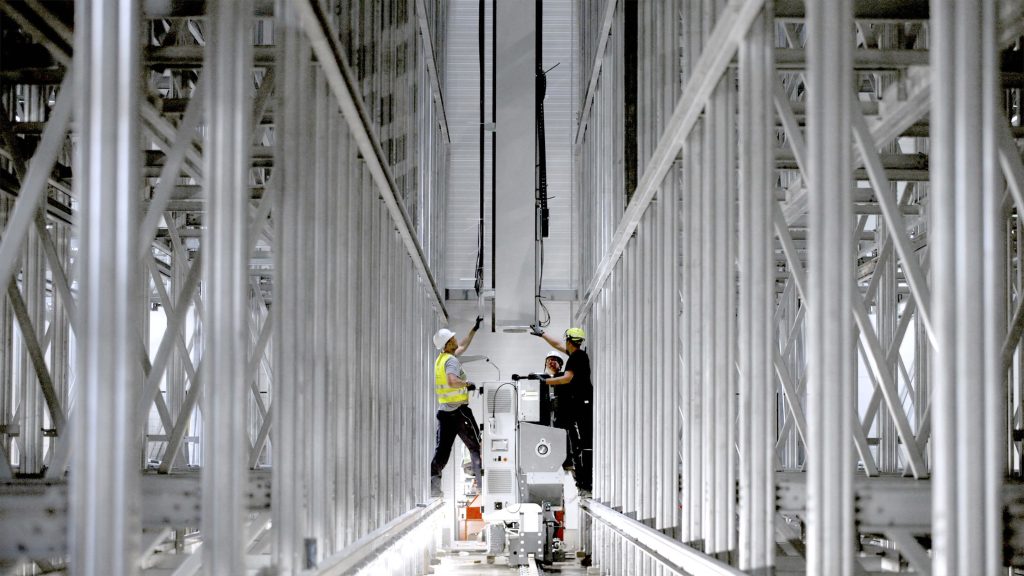
The answer is density. Block stacking uses around 30% of available building height. Conventional racking reaches approximately 60%. Automated storage systems use 90% or more, delivering around 300% more capacity within the same footprint.
Swisslog offers three technologies matched to different building types: vertical stacker crane systems for very high-bay buildings up to 48 meters, bidirectional deep-lane shuttle systems for buildings up to 45 meters with lower SKU counts, and 4-way roaming pallet shuttle solutions for irregular layouts and lower ceiling heights. Intelligent software coordinates all three in real time, integrating with existing WMS and ERP systems.
One major snack food manufacturer has worked with Swisslog for 22 years, increasing on-site storage by 300% across multiple projects without opening a new site.
Conclusion
The space problem in F&B manufacturing is structural, not cyclical. Manufacturers who invest in density find that the space they need was already there. It just was not being used.
For the full analysis, including a five-question diagnostic for your own site, a breakdown of the true cost of 3PL dependency, and a detailed guide to automation options, download the full white paper, “Full House: The Handbook for Handling the F&B Space Crisis”.
About us:
About Swisslog
Swisslog designs, manufactures and optimises automated logistics solutions across the supply chain, powered by our modular SynQ software platform. With a global team of passionate employees and a portfolio of best-in-class technologies, we partner with customers from solution design through lifecycle. www.swisslog.com/en-au
Contact details:
Jack Mallen-Cooper
Managing Director
Mallen-Cooper Whyte
T: +61 2 9901 4306