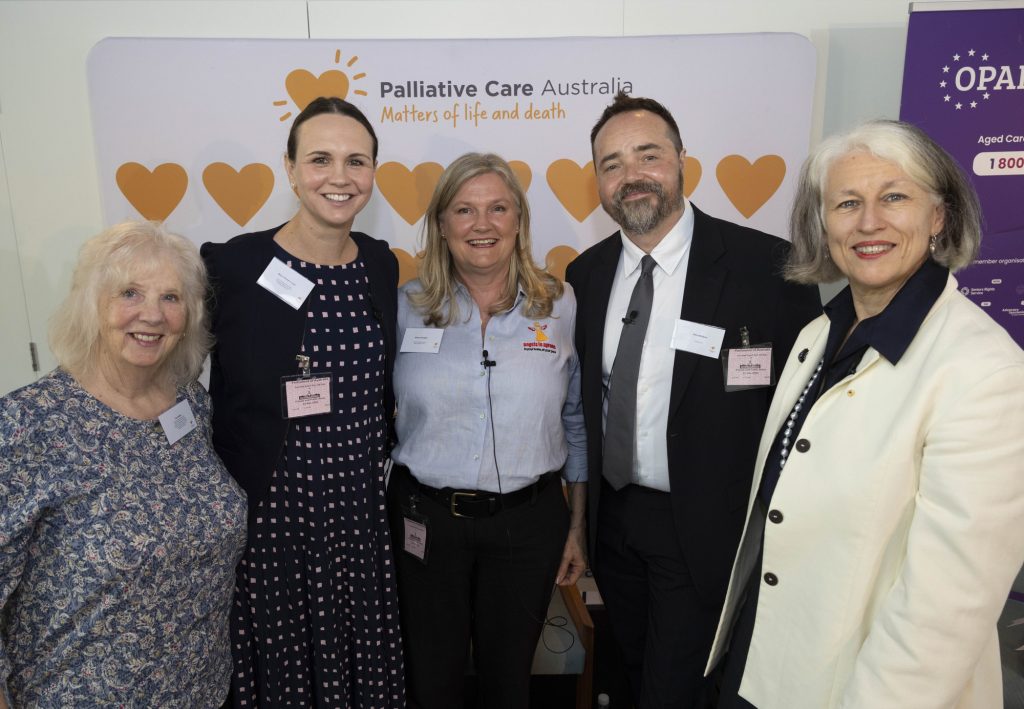
Older people, carers and aged care providers shared their experiences with parliamentarians at Australian Parliament House today, one year after the introduction of the new Aged Care Act. Palliative Care Australia (PCA) used the forum to call for action in the 2027 Federal Budget to help older people get palliative care sooner, whether they live at home or in residential aged care.
PCA hosted the Parliamentary Friends of Palliative Care event, Aged Care Reform One Year On: Stories and Reflections from Our New Rights-Based System, in partnership with the Older Persons Advocacy Network (OPAN).
The event featured a panel discussion with aged care advocate and carer Sue Watts, GP and carer Dr Mary-Therese Lucey, OneCare Chief Clinical Officer Glen Williams, and Angels in Aprons founder and CEO Sharon Douglas. The panel explored how families plan ahead, what happens when someone needs more help quickly, and what support makes it possible to die at home if that is their choice.
Genevieve Jacobs AM, Chief Executive Officer of Hands Across Canberra, moderated the panel and a discussion with Parliamentary Friends of Palliative Care co-convenor Senator Kerrynne Liddle and Rebekha Sharkie MP. PCA Chair Dr Peter Allcroft was the MC.
“Listening to older people, families and the people delivering care helps us understand where the reforms are making a difference and where more work is needed,” Dr Allcroft said.
“Older people have the right to make decisions about their care, including at the end of life. Real reform means ensuring older people can access the supports they need, when they need them, and that their choices and preferences are respected,” Craig Gear, OPAN CEO said.
In his closing remarks, PCA Chief Executive Officer Dr Chris Hatherly asked parliamentarians to back five proposals to help older people access care as quickly as possible. PCA’s five recommendations are listed in full below.
“Think of someone who’s ready to leave hospital and wants to spend the time they have left at home. Will the equipment they need be there when they arrive? Who can they and their family call if symptoms change overnight? Getting those details right can make going home possible,” Dr Hatherly said.
Watch today’s discussion to hear how families and providers navigate these decisions, from planning ahead to arranging care at home when someone’s needs change.
ENDS
Notes to Editors
Interviews
Images available on request. The following people are available for interviews on request:
- OneCare Chief Clinical Officer Glen Williams
- PCA Chief Executive Officer Dr Chris Hatherly and PCA National Policy Director Josh Fear
- OPAN CEO Craig Gear and OPAN Director, Policy, Systemic Advocacy & Education Samantha Edmonds
PCA’s 2027 Federal Budget priorities
PCA has set out five aged care proposals for the 2027 Federal Budget:
- Commission an independent evaluation of how using prognosis to determine eligibility affects access to palliative care pathways in aged care.
- Publish an independent public report every two years on access to quality palliative care in aged care.
- Improve aged care assessments by training assessors in palliative care and speeding up access to essential services and equipment for people approaching the end of life.
- Update the Support at Home service list to better support a palliative approach, including advance care planning and grief and bereavement services.
- Improve funding for GP and nurse practitioner home visits for people approaching the end of life who cannot leave home.
Aged care rights and standards
The Aged Care Act 2024 commenced on 1 November 2025. Its Statement of Rights includes equitable access to palliative and end-of-life care when required, and the right to make decisions and receive support to make them. The strengthened Aged Care Quality Standards set specific expectations for palliative and end-of-life care. www.health.gov.au
Aged care assessment review
PCA has called for the Australian Government’s independent review of aged care classification and prioritisation to explicitly address palliative care needs and include palliative care clinical expertise on its advisory group. PCA wants the review to consider how to support people whose care needs are already substantial and who do not yet qualify for the Support at Home End-of-Life Pathway. Read PCA’s response to the review announcement.
Residential aged care funding
At 30 June 2025, about one in a thousand permanent residential aged care residents with a current funding assessment were in the category for people admitted for planned palliative care (AN-ACC Class 1). Australian Institute of Health and Welfare data.
About us:
PCA is the national peak body for palliative and end-of-life care. OPAN is the peak body for individual aged care advocacy.
Contact details:
Alex Causton, Communication Manager, PCA [email protected], [email protected] or 0472 718 254
Jillian Marsh, National Communications Director, PCA [email protected] or 0447 034 067
Molly Houseman, Content & Media Officer, OPAN [email protected] or 0480 621 094