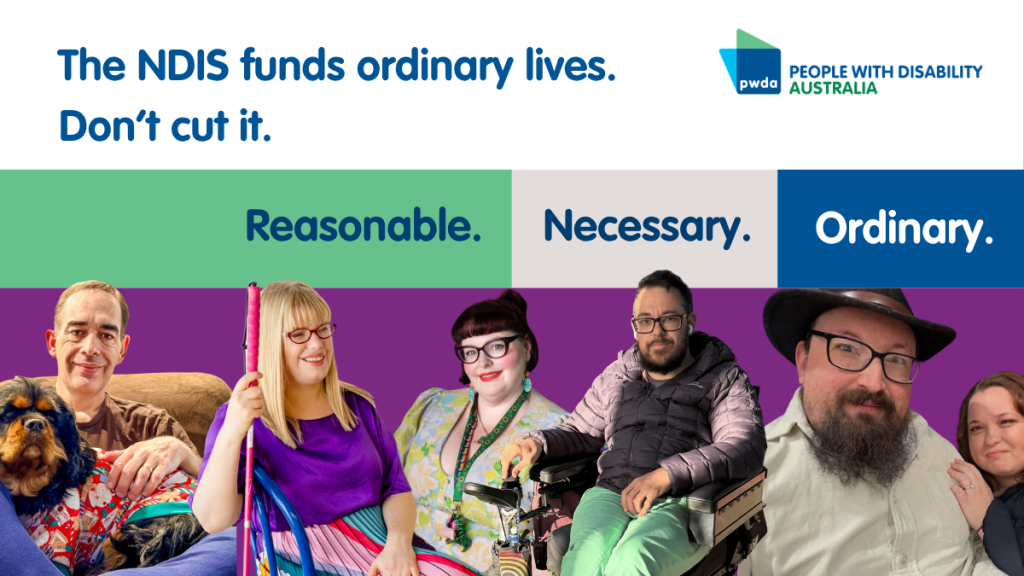
- PWDA launches Reasonable. Necessary. Ordinary. campaign to oppose expected NDIS spending cuts in upcoming Federal Budget
- Campaign emphasises NDIS funding supports basic daily living needs and contributes $2.25 to economy for every dollar invested
- NDIS enables participants to work, study and participate in community life, with 42% reporting improved life satisfaction
- Organisation warns cuts will shift pressure onto families, aged care, hospitals and crisis systems, while $60 million was spent fighting participants through tribunals in 2024-25
- PWDA calls for government to protect necessary supports, prevent eligibility cuts and focus on fixing system inefficiencies rather than reducing access
PWDA has launched a national campaign warning that expected reductions to NDIS growth will cut access to the supports people with disability rely on to live everyday life.
The “Reasonable. Necessary. Ordinary.” campaign, comes ahead of the Federal Budget, where the Albanese Government will further tighten NDIS spending.
PWDA President Jeramy Hope said the debate about the NDIS had drifted away from what it actually funds.
“I rely on about 25 to 30 hours of support each week. That support is not a luxury. It is what allows me to work, spend time with my family and stay out of hospital,” Mr Hope said.
“Without those supports, there is no me as people currently know me. No work. No ability to contribute. Less time with my family. Less stability. Less hope.”
Mr Hope said the language of “reducing growth” obscures the real impact of policy decisions.
“When governments talk about reducing growth, they are talking about cutting the supports people rely on to live ordinary lives. For people like me, the NDIS is what allows us to get out of bed, shower safely and be part of our communities.”
PWDA Acting CEO Megan Spindler-Smith said the campaign centres the everyday experiences of NDIS participants to show what is at stake.
“The NDIS does not fund extras. It funds the supports people need to live,” Mx Spindler-Smith said.
“For some, that is specialist training to safely leave the house. For others, it is support workers who make it possible to study, work and contribute to the economy. For many, it is basic assistance with meals, mobility and daily function.
“These are reasonable and necessary supports. They make ordinary life possible.”
PWDA has emphasised the scheme delivers both social and economic value.
“The NDIS is essential social infrastructure. It allows people with disability to live, work and participate in our communities,” Mx Spindler-Smith said.
“It returns $2.25 to the Australian economy for every dollar invested, and participants report a 42 per cent improvement in life satisfaction.”
PWDA rejected the framing of growth as the core problem.
“The NDIS was always going to grow. It is growing because more people are finally getting access to support that was denied for decades,” Mx Spindler-Smith said.
“Calling that growth unsustainable and cutting it is not a neutral budget decision. It is a cut to supports that shifts pressure onto families, aged care, hospitals and crisis systems,” Mx Spindler-Smith said.
PWDA has pointed to evidence of harm when supports are reduced or delayed.
“In 2024–25, $60 million was spent fighting participants through the Administrative Review Tribunal instead of funding their supports,” Mx Spindler-Smith said.
“We are seeing people deteriorate, being injured and, in some cases, dying. Deaths like Noah Johnston and Koa Gibson are the consequences of a system under strain.”
PWDA is calling for more attention on the impact of the scheme when it works, including a reduction in the number of younger people with disability living in aged care from more than 7,000 before the NDIS to 829 as of September 2025.
Mr Hope said the focus of reform should be on fixing system failures, not reducing access to support.
“There are pressures in the NDIS, and they are real,” he said.
“But they are coming from bureaucracy, delays and poor decision-making, not from people getting the support they need to live.
“The NDIS works. I am living proof of that.”
PWDA is calling on the Australian Government to protect access to reasonable and necessary supports, rule out blanket caps and eligibility cuts, commit to co-design, and focus reform on fixing system inefficiencies.
People with disability, families and allies can take action, including signing the petition at pwd.org.au/stopNDIScuts.
About us:
People with Disability Australia (PWDA), is a national disability rights and advocacy organisation led by, and for, people with all kinds of disability. We are a non-profit, non-government organisation and our membership is made up of people with disability and organisations mainly constituted by people with disability.
https://www.pwd.org.au
Contact details:
PWDA Media and Communications
0491 034 479